Closed-loop payments: what they are and when they make sense for your business
 6 min read
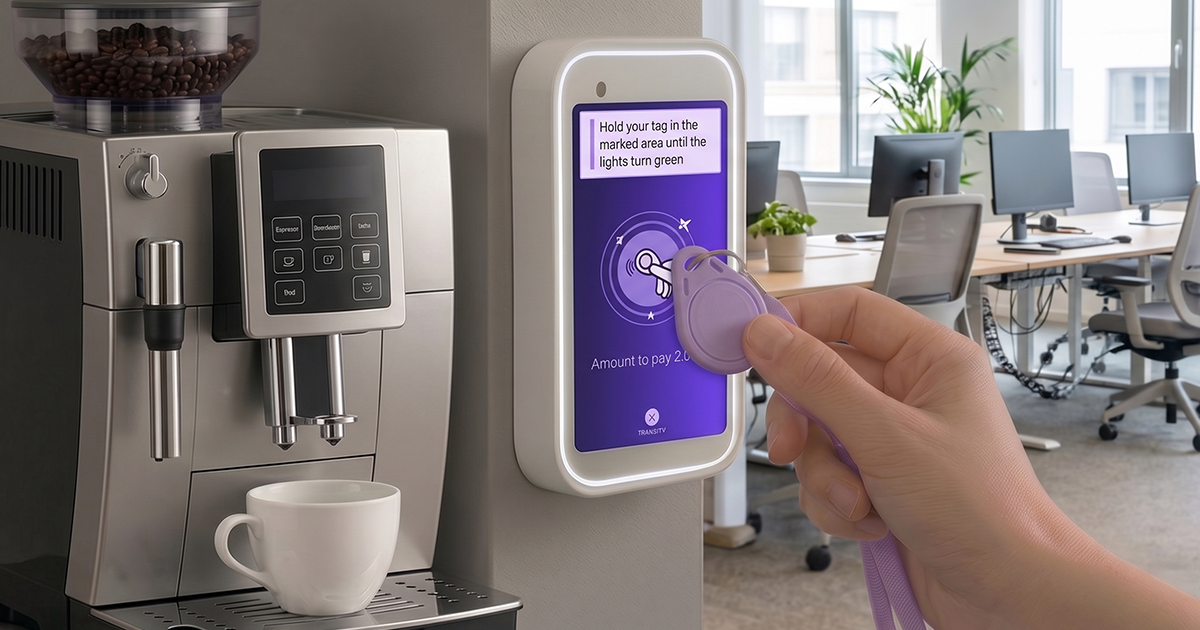
Not every payment needs a bank card. In a student residence, a corporate cafeteria, or a fleet of vending machines inside a private site, what you need isn't to open payment to every card on the market — you need to control who pays and where. That's a closed-loop payment, and it's probably the payment model most unattended operators misunderstand, even though many are already using it without realizing.
What is a closed-loop payment?
A closed-loop payment is a system where the payment method only works within a defined circuit: a company, a building, a machine fleet, or a specific location. In vending, this usually means NFC tags or top-up cards that an employee, resident, or customer tops up and uses exclusively on the machines authorized by the operator.
Open-loop payment, by contrast, accepts any bank card, Apple Pay, or Google Pay with no restriction on origin or destination. Both models are legitimate — they just solve different problems.
Closed-loop vs. open-loop: the real difference
The difference isn't technological, it's about control. With open-loop, anyone holding a valid card can pay at any compatible machine. With closed-loop, you decide who has access, to which machines, and under what conditions — something a traditional card reader can't offer, since it only distinguishes between valid and declined cards, not between users.
When does closed-loop make sense for your business?
Closed-loop makes sense when you need to restrict access or subsidize consumption, not just collect payment. These are the scenarios where it shows up most often:
- Corporate environments: subsidized vending or coffee for employees, where the company covers part or all of the cost per worker.
- Residences and universities: laundry or vending where only credentialed residents should have access.
- Multi-site fleets with fixed clients: machines installed inside a B2B client's premises (a factory, a hospital) where access must stay limited to that location.
- Loyalty programs with prepaid balance: the customer tops up a wallet card and uses it only within the operator's network, independent of their bank.
If your business serves the general public without restriction — a street-level machine, a car wash tunnel open to any vehicle — open-loop with card and mobile wallets is still the right call. This isn't about which system is better, it's about which problem you're actually solving.
How closed-loop with NFC works in Frekuent Space
Frekuent manages closed-loop payments through physical NFC tags linked to a machine, a location, or an entire company. From the dashboard you can configure an access whitelist: which tags are authorized, on which devices, and under what conditions.
Managing access doesn't mean registering tags one by one. You can bulk-upload the full list via CSV in a single step — especially useful if you're managing hundreds of credentials across a residence or an industrial site. When a tag is no longer authorized — an employee who leaves, a resident whose term ends — it's deactivated from the same dashboard, with no need to touch the machine itself.
Frekuent Spot reads Mifare Classic 1K/4K and Mifare DESFire tags, alongside contactless card, Apple Pay, and Google Pay — so the same terminal can run closed-loop and open-loop payments simultaneously, with no extra hardware.
Closed-loop vs. open-loop at a glance
| Aspect | Closed-loop (NFC/tag) | Open-loop (card/mobile) |
|---|---|---|
| Who can pay | Only users authorized by the operator | Anyone with a compatible card or wallet |
| Access control | Whitelist by machine, location, or company | No user restriction |
| Typical use case | Corporate vending, residences, B2B fleets | Public vending, laundry, or car wash |
| Managing offboarding | Remote tag deactivation, no site visit | Not applicable — no users to offboard |
| Frekuent Spot compatibility | Yes, same terminal | Yes, same terminal |
The most common mistake: picking one when you actually need both
The usual mistake isn't choosing wrong between closed-loop and open-loop — it's assuming the whole fleet has to run on one model. Most operators with machines across more than one type of site need both to coexist: closed-loop inside a client's factory floor, open-loop on the street-level machine. Forcing a single model across the whole operation usually means losing sales on one side or losing control on the other.
Another frequent mistake is treating closed-loop as a static setup. If adding or removing tags means physically visiting every machine, access control turns into the exact same operational problem you were trying to solve by going cashless in the first place: unnecessary site visits and manual work.
What your business gains from a well-run closed-loop setup
When closed-loop is managed from a centralized dashboard, three things change in a measurable way. First, adding and removing tags goes from minutes per machine to seconds per CSV upload. Second, the operator gets full traceability back: which tag, which machine, which amount, with no manual logs involved. Third, fraud risk tied to loose cash balances or unlinked top-up cards disappears — every purchase is tied to a specific, authorized tag.
Frequently asked questions about closed-loop payments
Does closed-loop payment need different hardware than open-loop?
No. Frekuent Spot reads both NFC tags for closed-loop and contactless cards and wallets for open-loop on the same terminal. You don't need a separate reader or two parallel systems on the same machine.
Can I deactivate an NFC tag without visiting the machine in person?
Yes. The whitelist is managed remotely from Frekuent Space. Deactivating a tag is instant and requires no action on the physical device.
Can closed-loop be used to subsidize or discount employee consumption?
Yes, that's one of the most common uses. You can attach specific conditions to a tag — a discount percentage or a monthly spending cap, for example — and change them from the dashboard without touching the machine.
Do I have to choose between closed-loop and open-loop for my entire fleet?
No. You can combine both models by location: closed-loop for corporate clients or residences, open-loop for publicly accessible machines, all managed from the same vending payment solutions dashboard.
Do you have machines in restricted-access environments and want to know if closed-loop fits your operation?
Tell us how your fleet is distributed and we'll tell you whether closed-loop, open-loop, or a mix of both is the right fit.
👉 Talk to sales
It's not about this sale.
It's about the next.
Scale your business by turning more visitors into regulars with the help of Frekuent. Get in touch to find out how you can get growing.
The real-time data and inventory tracking have made our processes smoother and more efficient. Definitely a must-have for growing businesses!
One of our clients say...